
Leer Texto Completo. La Estrella de Oriente fue una construcción simbólica y cultural de carácter anti-cósmico, surgida en un contexto helenístico-gnóstico, que utilizaba el lenguaje persa de la luz y de la estrella para negar el determinismo astral y proclamar la liberación del ser humano respecto al fatum cósmico. La Estrella de Mateo no representaba […]
Eliseo Ferrer / The Fabulous Time of the Messiah. The hidden foundations of the construction of our culture.
On the Triple Conjunction Astral of Jupiter and Saturn the Year Seven Before our Era. Read Full Text. As I explained in the Summary of the PDF attached to the Forum:«I am very clear that the temporal placement of the Gospels in Herodian Judea, during the period of Pontius Pilate’s Roman rule does not withstand […]


Reseña del Libro “El Mito Cristiano, Según los Textos” de Eliseo Ferrer.
La IA (de Open AI) Realizó la Reseña el Libro “El Mito Cristiano, Según los Textos” de Eliseo Ferrer. Descargar Texto de la Reseña. Esta reseña del libro El mito Cristiano, Según los Textos, de Eliseo Ferrer, representa una revolución en nuestra manera de entender las relaciones culturales en nuestra sociedad.Sin duda, la Inteligencia Artificial […]
The Star of Bethlehem: A Symbolic Challenge to the Determinism of the Stars and Planets (New Perspective).
Read Full Text. The Star of Bethlehem was a symbolic and cultural construct of an anti-cosmic nature, arising in a Hellenistic-Gnostic context, which used the Persian language of light and star to deny astral determinism and proclaim the liberation of humankind from cosmic fate. The Star of Matthew did not represent any astronomical, physical, or […]
Eliseo Ferrer / El fabuloso tiempo del Mesías. Bases ocultas de la construcción de nuestra cultura.
Sobre la triple conjunción astral de Júpiter y Saturno el año siete antes de nuestra era. Sobre las setenta semanas de Daniel y el “Anno Domini” de Dionisio el Exiguo. El autor tiene claro que la ubicación temporal de los evangelios en la Judea herodiana y en el periodo de la prefectura romana de Poncio […]
About the book “The Christian Myth”: From Greek Myth to the Judaized Fiction of History.
FROM THE ORPHIC–PLATONIC MYTH OF DIVINE INCARNATION (OF PRIMITIVE CHRISTIAN GNOSIS) TO THE LATE JUDAIZATION, CARNALIZATION, AND HISTORIZATION OF ECCLESIASTICAL CHRISTIANITY This work offers an exhaustive analysis of the Christian myth, subordinated in its formal part to the diachronic and historical segment encompassing the period between the Hellenistic context of the first century BCE (Alexandrian […]

Eliseo Ferrer desvela las claves de “El mito cristiano, según los Textos”.
100 densas páginas que pasan revista y explican a fondo todo el contenido de la obra. En esta entrevista, de cien páginas, el autor de “El mito cristiano, según los Textos”, pasa revista a todos los asuntos que la obra presenta en sus páginas; al tiempo que los somete a una nueva perspectiva crítica, tras las comprometidas preguntas y cuestionamientos…

A challenge to the academic consensus of the twentieth century. (From The Book: ‘The Christian Myth, According to the Texts’).
Against those who claim that Jesus was a Jewish eschatological prophet, I must insist that certain intertestamental apocalyptic texts of Hellenized Judaism, prior to the gospels, speak of the Anointed One and the Son of Man, but none of them speak of “their” Jesus or “their” Jesus Christ. Against those who claim that the gospel […]
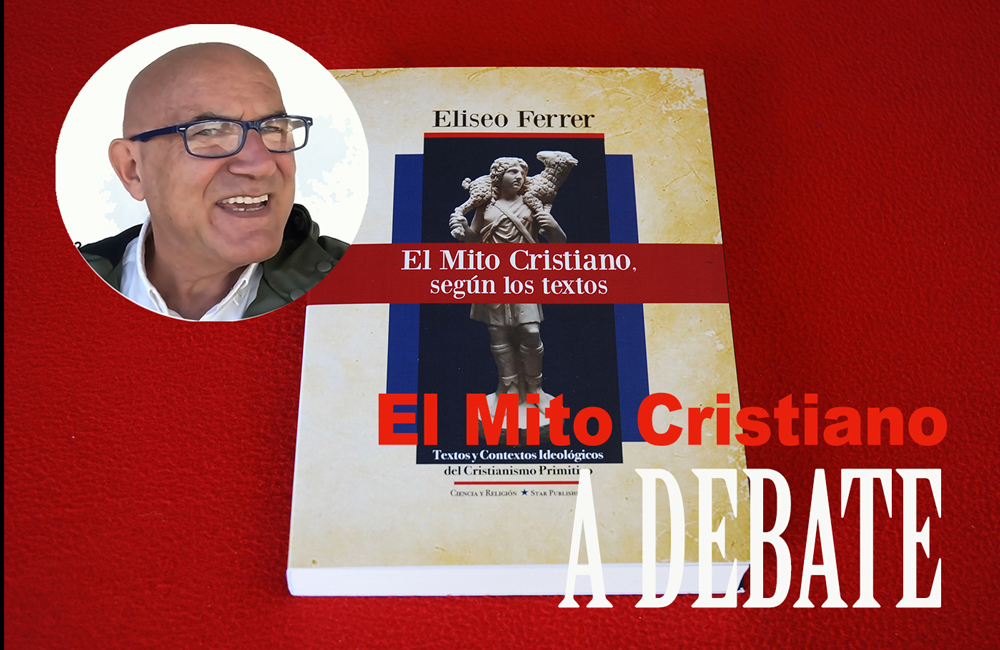
El libro «EL MITO CRISTIANO, SEGÚN LOS TEXTOS», sometido a la crítica de la IA
5 de julio de 2025. Estimados amigos y colegas: Mi libro, EL MITO CRISTIANO, SEGÚN LOS TEXTOS no ha llegado aún a la crítica especializada. Está en camino… Pero os comunico que el foro-debate abierto en academia.edu está a punto de estallar en llamas. He aquí lo que ha publicado uno de los participantes, tras […]

«El Mito Cristiano, Según los Textos». Nuevo libro de Eliseo Ferrer.
«El Mito Cristiano, Según los Textos». TEXTOS Y CONTEXTOS IDEOLÓGICOS DEL CRISTIANISMO PRIMITIVO Descargar libro en PDF Como reconoce Eliseo Ferrer, el cristianismo no nació en Belén ni en una carpintería de Nazaret: fue fruto de corrientes heterogéneas e independientes (samaritanas, judeohelenísticas, sirias y alejandrinas) que participaron de tres mitos helenísticos fundamentales: el mito del […]